What's going on with the Chagos Islands?
A tropical archipelago nearly 6,000 miles from Dover continues to make headlines after US President Donald Trump described the UK’s deal to hand over sovereignty to Mauritius as “ridiculous”.
the docket. looks at the legal background to the controversy and a constitutional tussle over the use of prerogative power to legislate for the territory.
UK defence secretary Wes Streeting told the BBC today that the government was reviewing its deal to hand the Chagos Islands over to Mauritius, after Trump used his first meeting with Andy Burnham at the UN General Assembly to describe it as “terrible” and “ridiculous”.
Streeting said the government would “have to do more work with our American allies, with President Trump and his administration, to get the deal to a place where he can support it”.
A quick history reminder
After being colonised by the French in the 17th century, the Chagos Islands were ceded to Britain under the Treaty of Paris in 1814. The Treaty handed the islands and nearby Mauritius to Britain at the end of the Napoleonic wars.
Amid post-war talks for Mauritius to gain independence from the UK, the British government separated the Chagos in 1965 and established it as the British Indian Ocean Territory (BIOT), using the royal prerogative. It paid £3 million (roughly £75 million today) as compensation to Mauritius, which became independent in 1968.
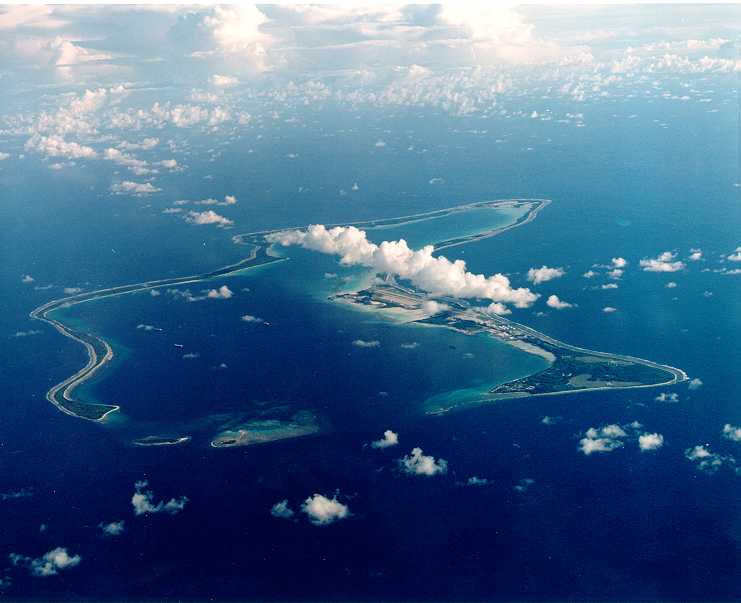
The establishment of the BIOT allowed for a UK-US mutual defence strategy based around Diego Garcia, the largest island in the archipelago. Under a 1966 exchange of notes, the UK permitted the US to use the BIOT for defence purposes until the end of 2016, with a possible extension until 2036. The US in turn granted the UK a $14 million discount on Polaris nuclear missiles.
Diego Garcia now accommodates fuel storage facilities, control towners, reconnaissance aircraft and military aircraft. It was used for US air operations in both the Gulf War and 2003 Iraq War.
The base came at a cost. In 1965, a commissioner was appointed to make laws for the BIOT. Under the commissioner’s direction, a huge number of Chagossians were displaced from the islands to Mauritius and the Seychelles between 1968 and 1973 in order to make way for Diego Garcia.
The House of Lords Library estimates this number as between 1,400 and 1,700. Human Rights Watch records that the entire Chagossian population from all inhabited islands in the archipelago was displaced.
The UK awarded Chagossians automatic British citizenship in 2002 under the British Overseas Territories Act. The Act applied only to those born on the islands and their children.
What’s the deal?
In 2019, the International Court of Justice issued a – non-binding - advisory opinion stating that the UK’s separation of the archipelago from Mauritius was unlawful, and that UK was now “under an obligation to bring to an end its administration of the Chagos Archipelago as rapidly as possible”.
It reasoned that when Mauritius – as a colony – agreed in principle to the detachment of the islands, it was not because of the free and genuine expression of the will of the people concerned. It asked the UK to respect the territorial integrity of Mauritius, concluding that the process of decolonising Mauritius was not completed when it gained independence in 1968.
Three years later, the UK and Mauritius engaged in talks. In 2025, the states signed an agreement under which the UK would hand over sovereignty to Mauritius, but would receive a 99-year lease allowing it to maintain the military base with the US. The UK would pay around £3.4 billion over the 99 years for the lease.
The UK was set to effect the ratification of the treaty through the Diego Garcia Military Base and British Indian Ocean Territory Bill, which was tabled in July last year.
But Trump withdrew his support in April, saying the US might require the Diego Garcia base for use in operations against Iran. And the UK needs US consent to ratify its agreement with Mauritius.
To ratify, the UK would need amendment of its 1966 agreement with the US, through a formal exchange. The US will now not provide their side.
So, we are at an impasse. The UK government is now back to the drawing board, facing pressure from the Mauritius government as well as Trump.
A constitutional tussle
There’s a constitutional curio to note in all of this. The establishment of the Chagos as a BIOT and the ordinances issued by the commissioner which led to the expulsion of Chagossians were made through Orders in Council.
Orders in Council are decisions made by the British monarch, acting on the advice of the Privy Council. Drafted by the government, they may be made by virtue of the royal prerogative – and, crucially, do not require parliamentary approval.
A further Order in Council followed in 2004, stating that no person has the right to abode in the Chagos Islands. It has been controversial, affording no opportunities for debate or scrutiny, and was deemed by the House of Lords to be susceptible to judicial review.
While a split ruling by the House of Lords upheld the use of the prerogative to legislate for the islands and block the return of Chagossians in 2008, this year saw a different story in the Supreme Court of the BIOT.
Four Chagossian claimants – including the first minister of the Chagossian government-in-exile – turned up in a yacht in the archipelago, over 100 miles away from Diego Garcia. They challenged the BIOT Commissioner’s decision to issue them with removal orders from their homeland.
The Supreme Court of the BIOT overturned the prohibition of the right to abode. Chief Justice James Lewis KC said there was no instance in which the royal prerogative had been used to exile an indigenous population, and there was no basis to remove the right to abode. He said:
“A claimed power to exclude a whole population must be justified by legal source, not administrative necessity.”
While the Lords had cited possible defence, security and financial concerns around rehabitation of the archipelago, Lewis CJ said the ability to rely on these had been removed by the terms of the 2025 agreement with Mauritius. The treaty contains an article giving Mauritius the freedom to implement resettlements on the islands, and Lewis CJ also cited the high amounts to be paid by the UK to Mauritius in connection with the treaty. As such, he found no justification for the use of the prerogative power to block Chagossians from returning home.